Parish Church of the Sacred Heart of Jesus, Pamplona
Written in August 2019August 2025 by Fco Javier Zubiaur Carreño
Historical Background
The canonical decree that established it was signed on March 1, 1979, by the archdiocese of Pamplona’s prelate, José María Cirarda Lachiondo. Its parish activities began 17 days later, provisionally, and for five years, on the first floor of Plaza Félix Huarte number 7. The first stone of the current parish temple was laid on April 23, 1983, and eleven months later, on March 11, 1984, the new church was consecrated as the definitive seat of our parish, built on a 750 m² plot adjacent to the Frontón de López in the Iturrama neighborhood, at 21 Serafín Olave street.
The parish was separated from that of Corpus Christi, along with the nearby parishes of San Francisco de Asís and Santa Vicenta María, due to the urban development of the western zone of the city and to pastorally care for some 9,200 parishioners residing in 2,300 homes located between Sancho el Fuerte and Navarra Avenue, including Esquíroz, Iñigo Arista, Serafín Olave, Iturrama, Pedro I, Alfonso el Batallador streets, and Félix Huarte Plaza.

Elevation of the Sacred Heart parish church and house (Source: Diario de Navarra)
The temple was designed by architect Miguel Tomás Arrarás Urdániz, author of the nearby St. John Bosco church in the Abejeras neighborhood, inaugurated the same year, with which it shares functional characteristics. The construction company was ACR and the site supervisors were Martín Aranguren and Sebastián Zalguizuri.
Its cost was around 50 million pesetas, of which the Archdiocese contributed 10 million from the inter-parish fund plus 4 million initially raised by parishioners. The Apostolate of Prayer, which had aimed to build a monument to the Sacred Heart and had opened a popular subscription for this purpose, gave the Parish 600,000 pesetas. The cost of selling the apartment that had been the provisional parish seat until then was added, with the remainder contributed by parishioner subscriptions.
The efforts to obtain construction permits from the City Council were arduous but were overcome by our first parish priest, Don Agustín García Larragueta, who even had to litigate to annul the urbanization fee demanded by the council upon the start of works, amounting to 1,785,620 pesetas, obtaining support from the Navarre Administrative Court which ruled in April 1985 exempting that fee.
From the beginning, parishioners and priests (Don Jesús Recalde Alzórriz formed the team with Don Agustín) agreed on the ideal upon which the parish community aspired to be based, understood as a community of small communities permeated by a welcoming climate fostering responsible coparticipation in parish activities; centered on the idea of the Risen Jesus, expressed in a way of living faith joyfully in the good news of salvation; and a missionary community in solidarity with those who suffer, according to Jesus’ desires proclaimed by His Word.
The architectural complex
It is composed of the church and the attached parish house. The church has an area of 500 m². It is a single-floor fan-shaped building, according to post-conciliar liturgical norms to encourage Christian participation during Holy Mass, with a slight slope and capacity for 500 people seated on benches, plus a small chapel for daily use that can be annexed to the larger parish space on days of greater attendance through sliding doors, and in whose space are located both the confessionals and the sacristy. At the time, it was innovative to have two small rooms at the entrance separated from the main nave by glass partitions intended for families with small children. The walls combine painted plaster with the brown exposed brick used for the complex, contrasting its roughness with the polished terrazzo floor. In the ceiling, electrical installations are concealed by a metal framework resembling a coffered ceiling, whose slopes converge in a circular-section lantern that provides light to the altar beneath it, crowned outside by a cross. The temple is also lit from outside through stained glass windows.
Attached to the church is the four-story parish building. On the ground floor are the three priests’ offices; on the first and second floors are rooms for meetings with parishioners, catechesis sessions and various groups; and on the third floor is the living quarters for the priests responsible for religious service.
The exterior entrances are protected by a canopy for the temple and a porch for the parish house.
The Parish is externally identified, to the east and south, by two crosses designed by parishioner Alfredo Díaz de Cerio, the second superimposed on the signage identifying the complex, made of lacquered aluminum.
 Exterior ornament

To the attractive volumetric contrast of the church with the parish house, the openings that rhythm the surfaces, and the small cross topping the lantern, are joined the aforementioned crosses designed by their author in 1984 and executed two years later in corten steel sheet (west facade) and aluminum (south, the later one), folded, welded, and matte black enameled with a light appearance and rear electric lighting, measuring 600 x 400 cm.
Both are Latin crosses with alternating rhythms: elongation and contraction of the ends, material and void in the design, lightening of horizontal lines against the ascending verticality of the longitudinal axis, and rear electric lighting which at night animates the voids, narrows the profiles, and enhances the symbol with delicate mysticism, thanks to the suggestive “photographic” effect of presence and suggestion of the cross, thus giving this Christian symbol significant value.

According to the artist, in its execution he sought to unite tradition with modernity, to identify the Christian character of a building which otherwise showed only a discreet attachment to religious worship. After placing the crosses, a label in uppercase reading PARISH / OF THE SACRED HEART OF JESUS was added at their base (whose design Díaz de Cerio did not participate in), made by Luminosos Arga Digital. It was a cross intended for a modern, developing neighborhood of young couples with some culture, receptive to a new concept of the cross on a traditional brick background. A cross understandable by its recognized design (horizontal + vertical), yet with a renewal air, with an artistic aspect recalling cold geometric movements (the suprematism of the Russian Malevitch and architectural rationalism in general), and the personal work of Navarrese architect Víctor Eúsa, who was led to reflect on two of his emblematic works (the Conciliar Seminary and the Church of the Paúles Brothers) about the expressive possibilities of the cross union with brick and the valued wedge shape in volumetric play. The result is that lightweight cross, with musical rhythm and mutable appearance, as it adopts two looks – morning and evening, and darkness – projected on the wall thanks to the strong perspective of the promenade.
In Alfredo Díaz de Cerio’s versatile work as painter, sculptor, ceramist, and poet, the sign of the cross is one of the iconographies that has most attracted him and that he has treated in diverse techniques and styles; in painting, expressionism is the most used concept to capture the gesture or body twisting due to the pain of suffering, though other versions are deeply poetic. In 1968 he created possibly his first Crucifix, to which several dozens have since been added, usually in small format, more interesting to capture the essence – which for him was the spirit – until the early 21st century, when he painted a series of Christs levitating over hazy horizons. The cross had a similar presence in his literary creation, explicitly – he wrote a poetic Via Crucis in 1969 – or through invocations to God expressing his search for the Absolute.
Worship images and interior decoration

The stained glass windows around the church’s exterior perimeter and the altar mosaic were works commissioned by the Parish to Domingo Iturgáiz, a Dominican artist. Using a language tending towards abstraction achieved by intentionally combining polychrome glass pieces joined with cement within an iron frame, the author depicted a full iconography of the high moments of Salvation History: creation of the world (water, light, cosmos), original sin (tree, fruit, serpent), Incarnation (Holy Spirit impregnates Mary), Birth of Jesus (cradle, star, Magi symbols), symbols corresponding to various Christ titles –Good Shepherd (staff, sheepfold…), Way to the Father (ascending path to Heaven), Living Water (spring), Light of the World (radiant flame), Life (vine and shoots), Love (radiant heart)– as well as the Redemptive Death of Christ (cross), Resurrection of the Lord (“passing” from death to New Life), Coming of the Holy Spirit (Pentecost, burst of light), and the Present Presence of Christ among us through Sacred Scripture (Bible, lamps of Faith lit), Eucharist (bread and wine, table and diners) and, as the culmination of Salvation History, the Kingdom of Heaven (God’s paternal welcome of His children). The stained glass series continues in the Chapel: knots symbolizing Christ’s union with men and men with Him, the chalice with the Sacred Host representing the Eucharist, the basket with bread referring to the Lord’s miracles and the Bread of Eternal Life implicit in the Eucharist, the Chrismon or monogram of Jesus Christ, Beginning and End of the universe, the  Cross in the form of a monstrance, the fish crowned by the Greek word ΙΧΘΥΣ (five letters that stand for Jesus Christ, Son of God, Savior but together mean fish and were used by persecuted early Christians to recognize each other), and the chalice with the Sacred Host before a tent, referring to Saint John’s words (1:14): “And the Word became flesh and dwelt among us”.
The spaces left free by the large stained glass windows of the church have been used to place the Stations of the Way of the Cross, with the peculiar addition of a fifteenth station of the Risen Jesus, emerging in all his majesty from the tomb, alongside which two Roman soldiers are terrified by the event. These are bas-reliefs made by Talleres de Arte Granda, Madrid, using the repoussé technique on brass plates imitating wood carving. The artworks from this workshop, founded by priest Félix Granda Buylla in 1891 and continuing to the present, are characterized by beautiful drawing, careful execution and depth of thought, summarized by dignity (serious attitudes without excessive tragic gestures), religiosity (speaking and teaching about Christ, here about His Passion), popularity (art that all can understand), and symbolism (each meaningful element linking to the spirit of medieval art).
 [
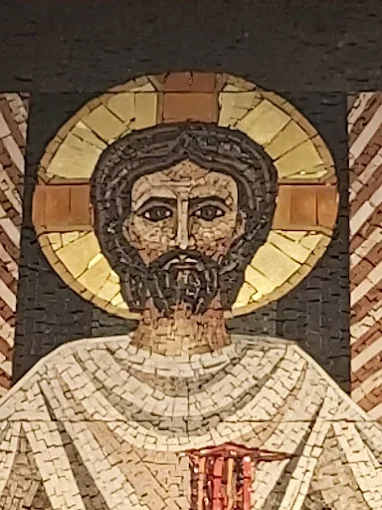
 Jesus Christ Risen is the representation that presides over celebrations from the High Altar, inspired by the artist Iturgáiz from the icon of an Egyptian Catholic nun at the Benedictine monastery of Our Lady of Calvary, Mount of Olives, Jerusalem, circa 1977. The author – same as the stained glass – used the mosaic technique, rooted in early Christian and Byzantine arts, though with some deliberate modifications. It is frontal, with visible wounds and arms outstretched over a cross with emphasized ends superimposed on a radiant image of himself. He is alive, with his open and bleeding heart, symbolizing his sacrifice for mankind’s salvation, but here the model’s red robe has turned white to symbolize Christ triumphant over death, who voluntarily displays the wound in his side to show the Heart that names the Parish. The predominant ochre tones are brightened by Murano glass tesserae resembling blood flowing from his pierced chest and the golden halo behind the head. Early Christians developed the custom of applying mosaic – which the ancient Greco-Romans used for flooring – to wall panels to avoid stepping on religious images depicted therein.
Alongside the mosaic, emblem of our Parish, presiding over the high altar is the statue of Our Lady of the Offering, showing a peculiar way of presenting the Child Jesus as offered by his Mother to mankind. Her Son leaves his Mother’s lap with arms open in an act of surrender, foreshadowing his future redemption of humankind through Incarnation and Passion, in a characteristically unbalanced Baroque movement. Mary stands on a pedestal, slightly leaning forward. She wears a simple beige tunic, actually the wood’s own color from which the figure was carved, with slight folds, a blue mantle fastened at the neck, and her head covered with a veil falling behind her right shoulder and partly covering the left in front, while the Child wears a simple tunic also veiled in white. The statue was made for our church in Russian pine wood in 1984 by Navarrese-Valencian artist José López Furió, using large synthetic planes that stylize her canonical proportions, whose serene classicism was not altered with flashy polychromy, merely waxing the surface lightly and painting two colors (blue and white) only barely applied, work entrusted by the sculptor to Pamplonese restorer Agustín Guillén López.

 In the presbytery is a simple baptismal font made of stone by a popular author, with a circular scalloped cup in rural Gothic style, originating from San Esteban de Janáriz church, Lizoáin municipality near Aoiz, resting on a semi-spherical pedestal on a square base decorated with balls at its corners (the shaft is reconstructed), measuring 100 x 76 cm, following the practice of our Diocese of recovering heritage pieces no longer used due to territorial depopulation or lacking clear purpose. In 2018, this font was moved to the temple entrance, in a specially made baptistery to better signify the entry into faith in Jesus Christ of new baptized. This diocesan practice also explains why a 16th-century Romanist-style image of the Virgin with Child, from San Pedro de la Rúa church in Estella, of unknown author, hangs on the Chapel’s side wall. The Child, seated on his mother's left arm, blesses with his right hand. At the Mother’s feet is the moon associated with her Immaculate Conception inspired by Saint John’s Apocalypse (12:1): “A great sign appeared in the sky: a woman clothed with the sun, with the moon under her feet, and a crown of twelve stars on her head.” The statue is gilt wood, polychrome and gilded to simulate brocade on the figures’ garments, whose fullness heralds the Baroque style.
 [
 Continuing in the Chapel, another fine piece of liturgical furniture is the tabernacle made by religious decorator Pedro José Villalba, Madrid, in the first third of the 20th century, neo-Romanesque bronze with inlays of ivory and polychrome enamel on its door, plus veined green marble columns, its structure resembling a Romanesque church portal with two archivolts over Corinthian columns with smooth shafts. The outer archivolt is decorated with interlaced triangles, with a smooth outer edge. The inner archivolt is adorned with continuous vegetal motifs, featuring a diamond-pointed relief edge. The tabernacle door has a diamond-pointed relief band and an outer border decorated with enamel forming intertwined vegetal stems alternating two shades of blue and ochre, using the “cloisonné” technique, and ten bronze flower buds scattered.
The door’s background shows flowers and stems arranged densely around a central medallion with the Good Shepherd’s figure symbolizing Jesus. This vegetal decoration is embraced below by smooth ribbons leaving a central space from which a fountain flows, being drank from by two deer made of ivory inlaid in bronze (doe on the right, stag on the left). The central medallion is elliptical, bordered by a leaf motif frieze, framing a metal enameled plate depicting the Good Shepherd as “moschophoros”: a young, handsome man carrying a lamb on his shoulders, with a crossbody satchel and in his right hand a sheaf of wheat and grapes, with a sheep at his feet. The whole ensemble is full of Eucharistic symbols: the “Living Water Fountain” to which the deer (people) come is Christ; the wheat and grapes the Good Shepherd carries are the Eucharist’s substance, and Christ, the “Eucharistic Lamb” eaten by all, is simultaneously the Shepherd of all humanity.
It measures 47 cm high by 38.5 cm wide. It is lodged in the wall of the Church’s side Chapel. It was donated in 1997 by the Catechist Ladies of the Social and Cultural Work Sopeña (OSCUS), who, for urban planning reasons, had moved residence from the San Juan neighborhood to Iturrama, having to close their open worship chapel.
 Religious iconography is completed, besides the processional cross, with the crucifix usually presiding over the Blessed Sacrament Chapel. These are images inspired by Christ during his agony, appearing suffering. But at Christmas, we joyfully kiss the Baby Jesuses carefully kept by our Parish, and the nativity scene, with challenging perspectives, beautiful figures, a spring, and lighting effects, stages the Savior’s birth.
The church artists
Alfredo Díaz de Cerio Martínez de Espronceda
(Mendavia, 1941-Pamplona, 2008). Self-taught, his interest in painting was awakened in 1962. Four years later he emigrated to Switzerland to work in a chemical company (1966-1967). During occasional trips to nearby countries, he encountered the paintings of Vermeer of Delft, Van Gogh, Kandinsky, Kokoschka, and contemporary German painting. He met the painter Margarethe Liebau Kornemann, author of expressionist inks. However, it was the Benedictine father Kunibert who organized his first exhibitions at the Brilon Stadt City Hall (1971). Kunibert, who introduced him to the work of Dürer, was the first to notice in him the strength of his inner world expressed in two directions: poetry and the expressive power of color. At the end of 1974 he returned to Spain and worked for two years in Zaragoza for the company Muresa, specialized in ceramic coatings. He was an assistant to the sculptor Ángel Orensanz, who sparked his interest in the structure, hollow, and flexion of sculptural forms. At this time he created his first zoomorphic clay models. He settled permanently in Pamplona in 1976.

Alfredo Díaz de Cerio (Photo: Paco Ocaña)
Well versed in Central European art, it can be said that his later stylistic directions were shaped in Germany: Post-Impressionism with strong tones and Cubo-Surrealism influenced by Ernst and Klee in the 1970s; Surrealism through the depiction of organic forms in the visionary style of Dalí and Tanguy, metaphysical constructions in the Italian manner, strongly abstract Expressionism with mystical-religious meaning expressed through low-relief painting to which he even added metals in the 1980s; and intense realism, already foreshadowed in his earlier metaphysical painting but now clearly referencing Antonio López during the 1990s. Through clay, he sought union with the cosmic environment, again resorting in his sculpture to surrealist and organic forms. His creative vitality also led him to produce inks, watercolors, and drawings, taking an interest in illustration and poster art. He published five books of poetry and received numerous awards in this field, such as the “Luis Rosales” and “Vicente Aleixandre” prizes. As a painter, he was awarded gold medals in Rheinfelden (II Spanish Art Exhibition, 1972) and Basel (1972). He held more than fifty solo exhibitions and as many group exhibitions both in Spain and Central Europe. Among the former, the retrospectives of 1994 at the Museo de Navarra and 2007 at the Uno2Tres Gallery, both in Pamplona, are noteworthy.
Fray Domingo Iturgáiz Ciriza, O.P.

Domingo Iturgáiz O. P. (Photo: Order of Saint Dominic)
(Villava, Navarra, 1932-2015). Doctor in Christian Archaeology from the Pontifical Institute of the Vatican, he was professor of Christian Art History at the Faculty of Theology of Burgos, and in his artistic facet, he was notable in the arts of mosaic and stained glass using Christian iconography. His encounter with the Dominican architect Francisco Coello de Portugal, author of the Leonese sanctuary of the Virgen del Camino, for whose Major and Minor Seminaries he created a 96 m2 mosaic altarpiece, confirmed his artistic vocation, showing debts to the Blessed Angelico (drawing, religious emotion, composition...) combined with concerns that arose under the influence of José María de Labra, a muralist painter, as knowledgeable in the craft as concerned about the social mission of art.
In the 1950s, the Dominican father José Manuel de Aguilar, founder of the Sacred Art Movement, aroused his interest in foreign art magazines. Carlos Muñoz de Pablos brought him closer to the specialty of stained glass. He held his first exhibition at the Madrid gallery Biosca, achieving resounding public and critical success. The most prestigious critics wrote about his work, highlighting his effort to open new paths to classical mosaic, endowing it with a plastic vigor affirmed in dynamic composition and a sober coloring achieved with exotic materials (bronze tube, flat glass, masonry scraps, laminated marble), which gave his mosaics “an expressionist tone of Romanesque root.”
Mosaic commissions followed in the next decade: Crucifixes for the Parish of Nuestra Señora de la Fuencisla (Madrid) and the Chapel of the Spirituality Center of the Society of Jesus in Loyola, and the Annunciation for the Chapel of the Convent of the Anunciata of the Dominican women of Monte Mario (Rome). In the 1960s, he undertook the creation of large stained glass windows, some of complex design (Churches of Nuestra Señora del Rosario de El Salvador and the Episcopal in Venice, Florida). After moving his workshop from Madrid to Villava, he executed stained glass for the Pamplona parishes of Santa Vicenta María, Corpus Christi, Corazón de Jesús, and for the parish of San Miguel Arcángel de Noain, and outside the diocese, for Saint Dominic Church of Miami and the Convent of Santo Domingo de Caleruega, Burgos.
Since 1995, he intensified his study of religious art, which resulted in publications such as Iconography of Saint Dominic of Guzmán, Saint Dominic of Pamplona, The Romanesque Chrismon in Navarra, Museography and Iconography of Saint Dominic of Guzmán, and The Angelico, Painter of Saint Dominic of Guzmán.
At the end of his life, his interest in mosaic was reborn but through still life, landscape, and portraiture that he took to private homes, using no longer conventional tesserae but sea pebbles, whose surprising luminous and chromatic properties, when combined in dynamically composed or truncated marquetry, showed the suggestive expression and extraordinary impressionist liveliness that he was capable of. “The symbiosis of stone-matter with spirit-form results for me in the final communication of a renewed life,” he wrote in Ars Sacra.
José López Furió

José López Furió (Photo: Fondo López Blasco)
(Benimaclet, Valencia, 1930-Pamplona, 1999). Disciple of his father, the image sculptor José López Catalá, son of a market gardener who after the Civil War became a marble worker. He studied Fine Arts at the San Carlos Academy in Valencia. Around 1960 he arrived in Alsasua as a Drawing teacher at the Vocational Institute, and during the seven years he remained there before his definitive move to Pamplona, he carved the three images of his parish - the Sacred Heart of Jesus, La Milagrosa, and Saint Joseph - which served as his letter of introduction. Three priests with strong sensitivity, don Cipriano Lezáun, don Carmelo Velasco, then rector of the Seminary, and don José María Imízcoz, influenced him to receive his first commissions from the Diocese. His artistic maturity soon came with the support of other personalities, such as don José María Zunzunegui, professor at the Seminary of Vitoria, and the industrialist from Legazpia don Patricio Echeverría, thus making professional incursions in Guipúzcoa.
Despite being a “weekend” artist, busy with his classes in Technical and Artistic Drawing at the schools El Redín and San Miguel de Aralar, and with his family, he was nevertheless capable of carving up to 300 statues, 200 of them for Navarrese churches. This required prior biographical studies of the Saints, to understand their character and transfer their psychological traits to the hands of the effigy, because they say everything about a person, in his words. Among his most appreciated works are the Virgin Milagrosa of Alsasua, the Pietà of the Brotherhood of the Knights Volunteers of the Cross of Pamplona, the processional floats of Cáseda, the Saint Joseph the Worker for the M.M. Josefinas of the Pamplona neighborhood of La Magdalena, the Saint Francis Xavier of the new pavilion of the Conciliar Seminary, the Sacred Heart of Jesus of the Convent of the same name on Media Luna Street, the Savior of Ibañeta, and the Immaculate Conception of the P.P. Reparadores of Puente la Reina. He also made carvings to fill the void of missing images (for the Monastery of Leire and Santa María de Eunate) and emotional reproductions, such as one of the Holy Christ of Javier, which was presented to the Holy Father, John Paul II, on the occasion of his visit to the sanctuary in 1982, and other copies for churches outside Navarre, even outside Spain (France, Venezuela, Ecuador…). In his Valencia homeland, he left some valuable carvings (Parishes of San Antonio and San Vicente Mártir de Cullera).
His preferred iconographies were the Virgin with Child and Crucifixes, but he did not discard other figures such as the Savior, the Immaculate, the Holy Family, and the Saints, in particular Saint Francis Xavier, nor processional floats, Stations of the Cross, reliefs, or dioramas. Many of these works were assisted by polychromers such as the Guillén family (Agustín and his son Roberto). In his concept, the religious image had to transmit a necessary anointing. This explains the purity, goodness, and spirituality that emanate from his statuary.
Stylistically, López Furió was a neo-figurative sculptor, because without renouncing the volumetric essence of the Romanesque or Gothic, without discarding the rhythm of the Baroque or forgetting compositional schemes of the great masters, he embraced the formal synthesis of modern creators. Within classicism, my sculpture is simplified and stylized, in any case I seek to innovate and not repeat myself, he affirmed. His admiration was equally divided among sculptors José Capuz, a Valencian similar to him in passing from Baroque to abstraction; Luís Marco Pérez from Cuenca, for having reached an exaggerated almost expressionist realism, a trend that was present in his secular sculpture with which he inaugurated the Pamplona “Conde de Rodezno” Art Hall in 1968; and the French Auguste Rodin, one of the fathers of modern sculpture.
Key Dates in the Early Development of the Parish
April 24, 1978. Appointment of the person in charge of the future Parish of the Sacred Heart of Jesus (don Agustín García Larragueta).
March 1, 1979. Episcopal decree establishing the Parish.
March 1, 1979. Appointment of the first parish priest (don Agustín García Larragueta).
March 5, 1979. First “Parish Communication to the parishioners.”
March 11, 1979. Beginning of the life of the Parish: First Mass in the provisional church.
March 18, 1979. First Baptisms in the Parish.
March 25, 1979. First “Community Dialogue on the Style of the Parish.”
April 11, 1979. First “Community Celebration of the Sacrament of Penance.”
April 14, 1979. First Easter Vigil and first parish refreshment gathering.
April 24, 1979. Beginning of the Catechesis for children.
May 14, 1979. First “Survey on the Style of the Parish.”
June 22, 1979. First “Parish Assembly.”
October 1, 1979. Preparation of the “Group of Catechists” begins.
October 4, 1979. First meeting of the Parish Administration Board.
October 5, 1979. The “Liturgy Group” begins.
November 3, 1979. Meetings of the parents of Catechesis children begin.
December 1979. First issue of the Parish Leaflet Our Parish.
October 14, 1980. “Adult Biblical Meetings” begin.
December 13, 1980. “Youth Dialogues” begin.
March 29, 1983. Construction of the Parish Church begins.
April 23, 1983. “Cornerstone” of the Parish Church.
March 11, 1984. Inauguration of the Parish Church.
December 8, 1984. The image of the “Virgin of Offering” is placed on the altar.
October 29, 1985. The first group of “Parish Catechumenate” begins.
April 11, 1987. The “Jairoi” Scout Group begins.
September 30, 1987. The “Oidajai” Group begins.
March 11, 1988. Blessing of the façade “Cross.”
October 26, 1991. First “Priestly Ordination” in the Parish (don José Javier Anaut Máinz).

The author (right) with Don Agustín García Larragueta in Villava, 2019
Glossary
Archivolt
Each of the overlapping arches arranged in a flared manner that form the doorway of a temple – or a tabernacle in this case – in Romanesque and Gothic arts or their later continuations.
Baroque Art
Artistic style characterized by lavish ornamentation, decorative elements, spectacle, the illusionistic use of optical effects, the prominence of the astonishing, and drama, which developed mainly in the 17th and 18th centuries.
Byzantine Art
Originating in Eastern Europe around the city of Byzantium (modern Constantinople), founded by Emperor Constantine in 330, as the product of the blend of Hellenistic, Roman, and Early Christian arts, predominated by Eastern tastes, which strongly influenced medieval Western culture.
Neo-Romanesque Art
Survival in the 19th century and first third of the 20th century of the Christian architectural style that dominated Europe between the 11th and part of the 13th centuries, but reinterpreted from the present, characterized by the use of semicircular arches, barrel and groin vaults, free-standing columns, and buttresses developed as basic architectural elements.
Metaphysical Art
Italian artistic movement from 1918 to 1921, created by Giorgio de Chirico and Carlo Carrà, especially linked to painting, which represented a visionary world connected with the unconscious, beyond physical reality.
Early Christian Art
Primitive Christian art up to the 6th century, which in the East continued after the split of the Roman Empire in the so-called Byzantine art.
Canon
Model or prototype that gathers the characteristics considered perfect in its genre, especially referring to the human figure that gathers the ideal proportions.
Corinthian Capital
Has the appearance of an inverted bell or basket overflowing with acanthus leaves (a plant with long, curled, thorny leaves), whose stems form a kind of volutes or spirals (caulicoli) at the four corners.
Cloisonné
French word describing the decorative technique, mainly on copper, whereby vitreous enamel is fired between the raised metal edges, although this enamel can be replaced by precious stones, glass, or other materials embedded in it, creating defined contours.
Corten
Type of steel with high content of copper, chromium, and nickel, which gives it a characteristic reddish-orange color and makes it resistant to corrosion.
Christogram
Symbol containing the first two letters of the word “Christ” in Greek and sometimes the Greek letters Alpha and Omega related to the following phrase taken from the Apocalypse of Saint John (22:13) referring to the Lord: “I am the Alpha and the Omega, the First and the Last, the Beginning and the End.”
Cross Potent
A cross that has small perpendicular crossbars at its four extremities.
Cube-Surrealism
A certain evolutionary phase in which the experiences of Cubism and Surrealism merged into a very peculiar style mixing the rational (geometric) with the subconscious (irrational), which can characterize certain evolutionary moments in the painting of Picasso, Matta, and other creators, particularly the Dadaists.
Gilding with Sgraffito
Technique used by gilders consisting of scratching with the tip of the stylus (special punch) the color applied over the gold leaf on wood, forming stripes or lines to try to imitate the richness of fabrics.
Expressionism
Artistic school and aesthetic tendency that, reacting against Impressionism, advocates the intensity of sincere expression even at the cost of formal balance.
Abstract Expressionism
Contemporary pictorial movement within abstraction, specifically informalist and materialist trends after World War II. It emerged in the 1940s in the United States and spread decades later worldwide, extending to sculpture.
Icon
Religious artwork of Eastern Christianity depicting Jesus, Mary, saints, angels, or biblical events, usually painted on a wooden panel but may be made of metal, carved in stone, embroidered, made in mosaic, repoussé, etc., whose main features are flatness and use of color.
Iconography
Description of the theme or subject represented in artistic images, as well as their symbolism and the attributes that identify the depicted characters.
Impressionism
19th-century pictorial movement that represents the motif and its chromatic appearance according to the impression that light produces on the viewer’s eye, rather than according to supposed objective reality. Its main representative was the French painter Claude Monet.
Neo-Figuration
Or neofigurative expressionist painting, an artistic movement of the second half of the 20th century characterized by a return to figurative painting in opposition to abstraction, although painters treat the subject matter informally and expressively. It arose as a reaction against abstract art after World War II, especially during the 1950s and 1960s.
Nimbus
Halo around the head of sacred images. In Christianity, it symbolizes the divine light that reaches human understanding, which will radiate around them.
Polychrome
Multicolored.
Post-Impressionism
Term applied to painting styles of the late 19th and early 20th centuries after Impressionism that continued to use bright colors, distinguishable brushstrokes, and real-life themes like the Impressionists, but sought to bring more emotion and expression to their painting as well as a more subjective vision of the world. Its representatives include Cézanne, Van Gogh, and Gauguin.
Architectural Rationalism
Movement born in Europe as a result of the devastating consequences of World War I, and also from tiredness of the over-ornamented Art Nouveau, focusing interest on a new aesthetic based on the use of new construction materials (steel, concrete, glass), following concepts like structure and function serving human activity, designing geometric forms at right angles under a dynamic idea of architectural space.
Repoussé
Artisanal technique consisting of working sheets of metal, leather, or other malleable materials to obtain an ornamental figure in relief.
Romanism
Pictorial and sculptural trend of European Mannerism in which the style of Italian artists who worked in Rome during the High Renaissance was imitated, mainly Raphael and Michelangelo.
Suprematism
Avant-garde artistic movement focused on fundamental geometric shapes (particularly the square and circle), formed in Russia in 1915-1916 led by Kazimir Malevich.
Surrealism
Movement of literary origin and wide artistic diffusion, whose first manifesto was made by André Breton in 1924, which aims to surpass the real by promoting the imaginary and the irrational through psychic automatism.
Marquetry
Work made with fragments of various materials that are embedded into a whole forming a representation.
Glazing
Technique consisting of applying very thin layers of paint over a surface, so that the underlying layers shine through beneath the upper ones, mixing the chromatic effect of both.
Bibliography
ALIENDE RODRÍGUEZ, Jorge. The religious sculpture of José López Furió (1930-1999) in the city of Pamplona. Final Degree Thesis in History. Pamplona, University of Navarra, 2014. Unpublished text.
SAME AUTHOR. “The sculpture of López Furió outside Navarra”, Príncipe de Viana, Year 76, No. 262, 2015 (Issue dedicated to: VIII General Congress of the History of Navarra: Communications. Modern History. Contemporary History. Art History and Heritage. Volume II), pp. 929-940
DOMEÑO MARTÍNEZ DE MORENTIN, Asunción. “Popular Art”, in GARCÍA GAÍNZA, M. C. Art in Navarra. Pamplona, Diario de Navarra, 1994, volume 2, pp. 626-631.
EQUIZA, Jesús. “Urbanism and parishes in Pamplona and its surroundings”, in Vasconia: notebooks of history and geography, no. 29, pp. 47-65. Donostia-San Sebastián, Eusko Ikaskuntza, 1999.
[GARCÍA LARRAGUETA, Agustín]. Our Parish, Bulletin of the Heart of Jesus Parish of Pamplona, no. 84, June 1999.
And information provided to the author on August 26, 2019.
HALL, James. Dictionary of art themes and symbols. Madrid, Alianza Editorial, 2003. Two volumes.
VALLE, Eusebio. “Mosaics by Fr. Domingo Iturgaiz”. Locator: http://www.dominicoshispania.org/mosaicos-de-fr-domingo-iturgaiz/ Updated: 12/26/2003. Accessed: 05/15/2015.
VARIOUS AUTHORS. Guide to urban sculpture in Pamplona. Pamplona, Pamplona City Council, 2009 (also at http://esculturas.pamplona.es)
WIKIPEDIA. Félix Granda. Locator: http://es.wikipedia.org/wiki/Félix_Granda. Updated: 03/11/2015. Accessed: 05/15/2015.
Diario de Navarra from March 23, 1983, p. 13 of Diario 2.
Navarra Hoy from March 12, 1984, p. 5.
And publications by the author.
Category: Art History | Tags: Agustín García Larragueta, Agustín Guillén López, Alfredo Díaz de Cerio, Contemporary art from Navarra, Domingo Iturgáiz Ciriza, Félix Granda Buylla, Jesús Recalde Alzórriz, José López Furió, Miguel Tomás Arrarás Urdániz, Pedro José Villalba, Talleres de Arte Granda, Virgin of the Offering.